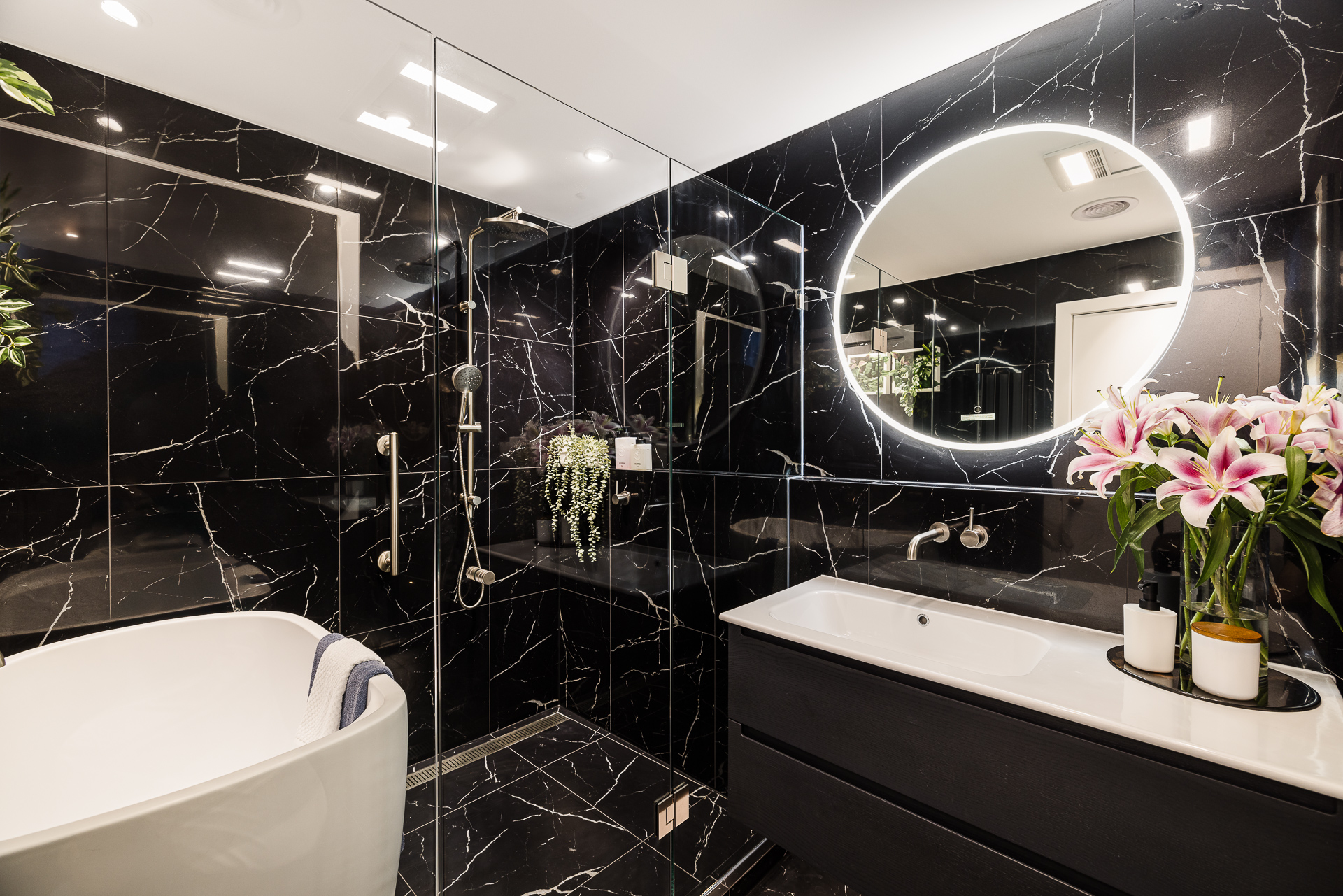

The bathroom is where a renovation's quality is most quickly revealed. Not in the tiles, nor the fixtures — though those matter — but in what lies behind them. A well-built bathroom is watertight, well-ventilated, and engineered to perform for decades. A poorly-built one will announce itself within two. This is a guide to what you should expect, and what you should ask for, when renovating a bathroom in Melbourne.
Understand what's behind the tiles
Most bathroom failures are invisible. They begin behind a wall, beneath a floor, at the edge of a shower tray — in the waterproof membrane that nobody sees after the tiler has finished. Waterproofing is not a finish. It is an engineering decision, regulated under the Australian Standard AS 3740, and it is the single most important element of the build.
If your builder talks about waterproofing as a ten-minute task between tiling and painting, hire someone else.
A correctly-built bathroom will have a certified waterproofer apply a two-coat membrane system, with a mandatory cure time of 48 to 72 hours before tiling begins. Any fall of the floor toward the drain must be set in the screed before tiling — you cannot fix a bad fall with tile adhesive. Any shower without a hob requires a continuous fall of the entire bathroom floor to be correctly graded. Detailing at wall-floor junctions, around penetrations, and into the shower tray is where expertise shows.
Plan the layout carefully — plumbing is expensive to move
Moving a drain line is one of the more expensive decisions in a bathroom renovation. Where possible, we recommend working within the existing wet-wall footprint: keeping the toilet, shower waste, and vanity outlets roughly where they are, and changing what's above the floor. When the footprint does need to change — which it often does in older Melbourne homes — plan it before the design is finalised, not during construction.
Think about how the space is used in sequence: entry, vanity, toilet, shower. The best-planned bathrooms have a clear sequence that feels natural to move through. A vanity that you bump into on the way to the shower is a plan that needed another draft.
Timeline: tighter than a kitchen, more dependent on cure times
A standard bathroom renovation takes four to eight weeks from site commencement. The sequence is largely fixed:
- Demolition and strip-out — 2 to 3 days
- Plumbing and electrical rough-in — 3 to 5 days
- Wall sheeting and floor screeding — 3 to 5 days
- Waterproofing (plus 48-72 hour cure) — 4 days minimum
- Tiling — 5 to 10 days, depending on pattern and tile size
- Plumbing and electrical fit-off — 2 to 3 days
- Shower screen and glazing — 1 day (plus 1 to 2 week lead time on measure)
- Silicone, final clean, handover — 1 to 2 days
The cure time on waterproofing cannot be compressed. Builders who promise a three-week turnaround on a bathroom renovation are either skipping that cure period or they are not doing the waterproofing properly.
Material decisions that matter
Tiles are where most of the visual weight of a bathroom sits, and they are also where lead times bite. Imported stone, handmade tiles, and specialist formats can run to twelve weeks. Lock your selections in before demolition begins.
A few material decisions we find often get underestimated:
Grout colour. It is one of the quietest but most transformative decisions in a bathroom. A white tile with black grout reads entirely differently from the same tile with a warm cream grout. On our current Elm Grove project in Kew East, coloured grout is one of the defining elements of the bathroom scheme.
Tap and fixture finish. Solid brass fixtures and electroplated fixtures can look identical in a showroom. They do not age the same way. For a build you intend to hold for twenty years, the difference is material.
Vanity construction. A vanity in a wet environment needs to be built for it. Moisture-resistant substrates, sealed edges, and concealed fixings — these are not places to save money.
Lighting is usually underdone
Most bathrooms are lit by a single downlight above a mirror — which is exactly the wrong place for it. Good bathroom lighting works on three layers: natural light where possible (skylights are worth considering in interior bathrooms), ambient general light, and task light at the mirror. Task lighting should be either side of the face or in front of it — not directly overhead, which casts shadows under the eyes.
Ventilation matters more than you think
The mandatory exhaust fan in most bathrooms does the minimum the code requires and often not much more. In a bathroom that sees daily use, we recommend a higher-capacity extraction fan, ducted to the outside (not the roof cavity), and ideally run on a timer or humidity sensor. The return on this decision, measured in mould prevention alone, is disproportionately high.
Budget for the unexpected
Bathrooms have more unknowns than any other renovation. Behind the tiles of a fifty-year-old Melbourne home, you may find lead-jointed copper plumbing, inadequate falls, no ground-to-wall drainage, or rotting substrates. We advise a contingency of 15 to 20 percent for bathroom renovations — higher than we'd recommend for kitchens.
Fixtures themselves will consume more of your budget than most people expect. A mid-range tapware suite for a single bathroom — basin mixer, shower mixer, shower rose, bath mixer and spout, toilet — will typically sit between $3,000 and $8,000. Quality matters here, not only for longevity but because cheap fixtures feel cheap the first time you use them.
How Atelier approaches it
We treat a bathroom renovation with the same discipline as a structural build, because at the layer that matters — the membrane, the falls, the junctions — that is exactly what it is. Our bathroom projects are delivered to certified waterproofing standards, with trades sequenced to respect cure times and detailing planned at design stage.
Our most recent bathroom project, The Luxe Retreat in Clayton, was delivered in collaboration with LN Design. It is a good example of how material cohesion, proportion, and considered light resolve into a bathroom that feels genuinely restorative — and will do so for as long as the home stands.
If you are considering a bathroom renovation in Melbourne and would like to discuss your project, we would be glad to hear from you.
Ready to Begin?
Share your brief and Rodney will be in contact within one working day.
Begin Enquiry